
Skip to content
Solutions

Solutions organized around operational work, teams, and outcomes.

Choose the fiber workflow that needs attention, then connect it to the network record without creating another isolated data silo.

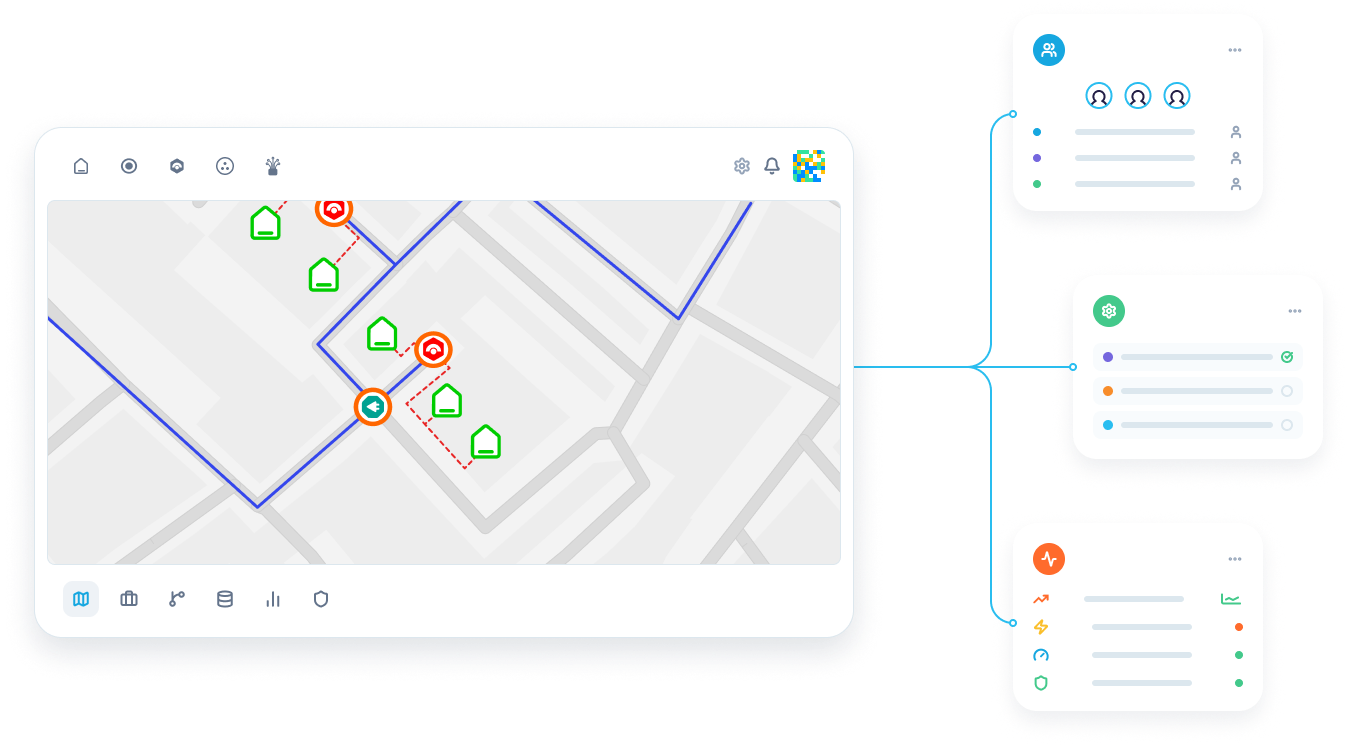
Illustrative fibre network map with operational workflows across teams and outcomes.

Choose a concrete path into the platform.

Choose the operating situation closest to the work in front of you. Each path starts with a route, work package, network object, or acceptance decision.

By workflow

Move an approved route into an accepted as-built record.

The problem: An approved route and work package can lose their connection to field deviations, closure evidence, and the asset record needed by operations.

Weezie workflow

  1. 1Release the approved route and linked work package to the field crew.
  2. 2Record a field deviation against the route, closure, fiber, or installed asset and attach the required evidence.
  3. 3Validate the submitted evidence and the changed network objects before an acceptance decision.
  4. 4Update the accepted as-built record so inventory and operations use the same route and asset state.

Integration boundary

ERP continues to own procurement and finance, workforce systems own rosters and payroll, identity systems own credentials, OSS owns service operations, and GIS remains authoritative for enterprise mapping where it already is.

Expected operational outcome

Operations receive an accepted route and asset record with the deviation and acceptance decision still connected to the work package.
Explore planning and design

Connect the full lifecycle or improve one stage first.

Use one connected operational model from the first survey through the installed network, or begin with the stage creating the most friction today.

  1. Survey and capture

    Collect structured geometry, forms, photos, measurements, and asset evidence at the source.

  2. Plan and design

    Create network designs with topology, capacity, constraints, materials, scenarios, and visible validation.

  3. Build and coordinate

    Turn approved designs into controlled work packages for internal crews and delivery partners.

  4. Validate and hand over

    Check evidence, measurements, splice results, deviations, and approvals before operational acceptance.

  5. Operate and maintain

    Keep current assets, connectivity, work history, capacity, incidents, and field context available to operations.

  6. Integrate and report

    Connect operational systems, APIs, events, warehouse feeds, and governed reporting boundaries.

Give every team the context they need, without splitting the data.

Each team sees only the context required for its work. Contractors, for example, see the assigned geography and work package, while network objects, evidence, and decisions remain connected across handovers.

Design and engineering

Build and review network designs with assumptions, alternatives, rules, quantities, and approvals in context.

Field and construction

Give crews map-first work, materials, evidence requirements, tests, and offline-ready execution.

Inventory and warehouse

Align stock, reservations, installed assets, replacements, ownership, and physical availability.

Operations and maintenance

Trace connectivity, understand impact, plan work, and preserve the evidence behind changes.

Management and governance

See progress, quality, accountability, exceptions, program performance, and operational risk.

Splicing teams

Connect splice plans, actual fiber relationships, tray context, measurements, and the live network record.

Use connected operations to improve measurable network outcomes.

Connected operations make quality, delivery, readiness, and accountability easier to improve because the evidence behind each outcome remains visible.

Deliver faster

Reduce handover delay and repeated interpretation between design, construction, field, and operations.

Reduce rework

Find missing context, rule failures, incomplete evidence, and deviations before they become downstream problems.

Improve confidence

Make data quality, ownership, evidence, approvals, and the resulting network state easier to verify.

Strengthen governance

Preserve who changed what, why it changed, what was approved, and which version is operationally authoritative.

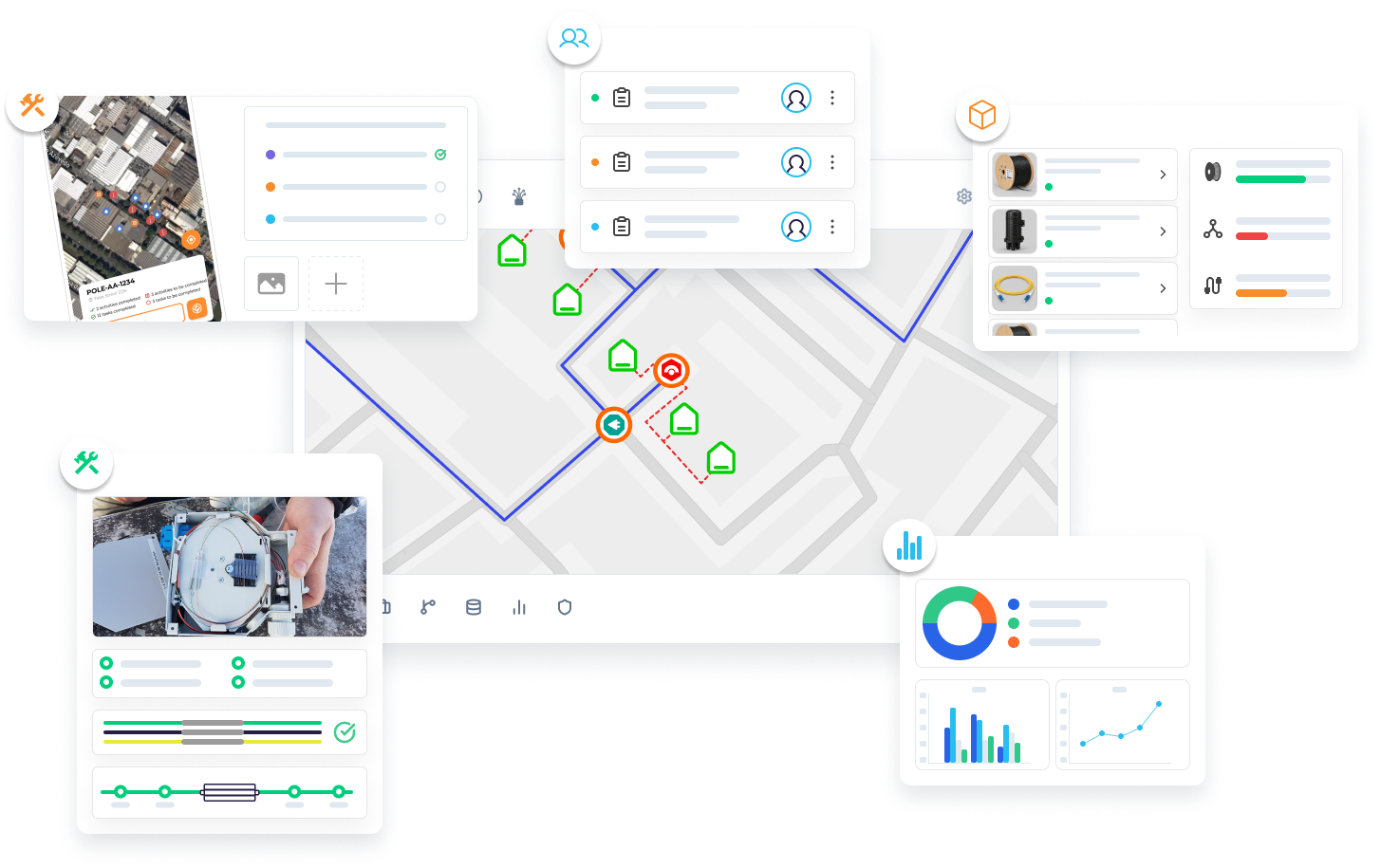
Illustrative connected operational record combining field, work, inventory, splicing, and reporting.

Clear entry points for different transformation programs.

The platform can support a broad transformation program, but it does not require a big-bang implementation. Start with a workflow, preserve the shared model, and expand deliberately.

Network data integration

Define system ownership, stable identifiers, APIs, events, bulk movement, failure handling, and reporting boundaries.

Start with an architecture review
Connected operations

Bring us the workflow that is slowing your network down.

Show us the current handovers, data gaps, tools, and operating constraints. We will map the platform to the real workflow rather than a generic feature tour.